Evaluate CV Joint Suppliers at China Auto Parts Trade Shows
Industry news
2026-06-10
Evaluating CV joint manufacturers at a large auto parts exhibition should not feel like finding a needle in a haystack. A procurement engineer can physically inspect samples from a dozen suppliers in one day, compare forging methods and heat treatment approaches, and leave with a shortlist of manufacturers that merit a factory audit. The difference between a productive visit and a wasted trip comes down to knowing what to look for at each booth. I have spent over a decade organizing automotive trade exhibitions in China, and I have observed that buyers who prepare a structured evaluation framework consistently build stronger supplier relationships. They know exactly which questions separate a capable manufacturer from a booth with good samples.
What Makes a CV Joint Exhibition Worth Your Time
Not every auto parts exhibition in China delivers the same value for CV joint procurement. The exhibitions worth attending share three characteristics: organized product zoning that clusters driveline and chassis components together, a high proportion of exhibitors from established manufacturing clusters like Yuhuan and Ruian in Zhejiang Province, and a buyer profile that includes procurement engineers rather than general visitors.
When walking into a large exhibition hall, the first indicator of quality is how the floor plan maps to supply chain logic. A show that scatters CV joint manufacturers across random aisles wastes your time. The exhibitions I have helped organize place all chassis and driveline exhibitors in contiguous zones precisely because procurement teams need to compare suppliers efficiently. Shanghai-based exhibitions drawing large international buyer audiences typically offer this structure as a baseline.
The exhibitor mix matters more than the total booth count. A show with 2,000 exhibitors where half are automotive interiors and accessories does not serve a CV joint buyer nearly as well as a focused event with 500 exhibitors concentrated in powertrain, chassis, and driveline categories. Target exhibitions where at least 15 to 20 driveline component manufacturers exhibit. This density justifies the trip.
How to Evaluate a CV Joint Booth in 30 Minutes
Walking onto a CV joint manufacturer’s booth without a plan means you spend ten minutes on pleasantries and leave with a glossy brochure and no real information. A 30-minute booth evaluation follows a sequence that moves from physical inspection to process questions to commercial terms, in that order.
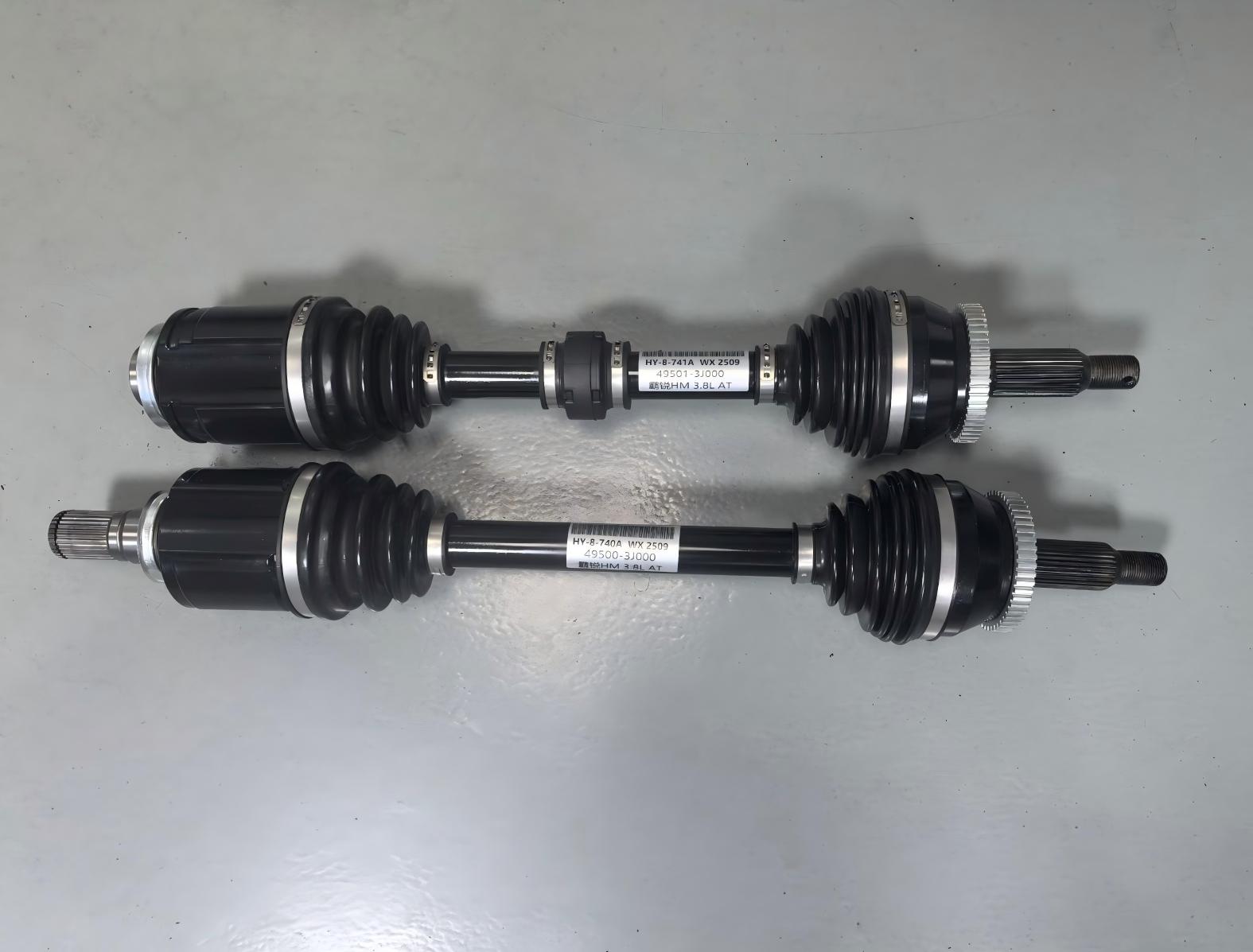
Start with the samples on display. Pick up a CV joint and examine the machining finish on the ball tracks and cage surfaces. These surfaces carry significant load in operation, and their finish quality reflects the manufacturer’s precision grinding and heat treatment capability. Look for consistent surface texture across all six ball tracks. Variation between tracks on the same joint suggests process control issues that will show up in batch consistency. Check the boot material at the same time. A CV joint is only as durable as its boot, and whether the supplier uses chloroprene rubber, silicone, or thermoplastic elastomer tells you whether they understand application-specific durability requirements.
After the physical inspection, ask the booth engineer three specific questions. What material grade does the outer race use, and can they show you the material certification for the displayed samples? Which forging method does their production line use, hot forging, warm forging, or cold forging, and how does that choice affect grain flow in the finished part? What is their standard heat treatment specification, including case depth and surface hardness ranges? A manufacturer that answers all three with specific numbers rather than general reassurances has invested in process control worthy of your shortlist.
Move to commercial terms only after the technical discussion. Manufacturers that lead with pricing before discussing specifications are often trading companies without production capability. At an exhibition with organized product zones, you can repeat this 30-minute evaluation with five or six CV joint suppliers in a single afternoon, then compare notes while the details are fresh.
If your CV joint program involves specific application requirements such as high-angle operation, extreme temperature exposure, or extended service intervals, it is worth confirming the relevant test data before adding a supplier to your shortlist. Reach out to the exhibition organizer in advance to identify which exhibitors specialize in your segment. This alone can save hours of walking the floor.
Certifications and Documentation to Request at the Booth
A booth visit is not a factory audit, but the documentation a manufacturer brings to the exhibition reveals how seriously they take quality systems. The single most important document to request is the IATF 16949 certificate, which governs quality management for automotive series production. Check three things on the certificate: that the issuing body is an IATF-recognized certification body, that the scope covers CV joint or driveline component manufacturing specifically rather than a generic automotive category, and that the certificate is current. An expired or narrowly scoped certificate is a red flag.
Beyond IATF 16949, ask whether they hold material test reports for the steel grades used in their CV joint production. A manufacturer supplying to European or North American aftermarket chains typically maintains EN 10204 3.1 or 3.2 certification covering raw material traceability. If they supply to OEM programs, they may also hold customer-specific approvals, which they should be able to reference by program name.
Request a copy of their dimensional inspection report for the displayed samples. This report shows whether their in-process measurement capability matches the tolerances they claim. For a CV joint outer race, pay attention to the ball track profile tolerance and the spline dimensions. A manufacturer that cannot produce this report in five minutes at their booth either did not bring it or does not generate it systematically. Neither answer inspires confidence.
The documentation review takes ten minutes and tells you more about a supplier’s operational discipline than any amount of booth decoration.
Comparing CV Joint Suppliers Across the Exhibition Floor
After visiting several booths, the challenge shifts from individual evaluation to cross-supplier comparison. Without a structured comparison method, the supplier with the best English-speaking sales manager or the most polished display can disproportionately influence your shortlist, even if their manufacturing capability is average.
Create a simple comparison table before you start walking the floor. Rate each supplier on five dimensions that matter for CV joint procurement. The table below shows how a typical comparison might look after visiting four manufacturers at a single exhibition.
Supplier
Material Cert Available
Forging Method
IATF 16949 Current
Sample Finish Quality
MOQ Range
Supplier A
Yes, EN 10204 3.1
Hot forged
Yes, full scope
Consistent track finish
500–1,000
Supplier B
Yes, mill cert only
Cold forged
Yes, full scope
Minor surface variation
300–500
Supplier C
Not available at booth
Warm forged
Expiring in 3 months
Good, one track rough
1,000+
Supplier D
Yes, EN 10204 3.2
Hot forged
Yes, full scope
Excellent, uniform
500–800
The comparison table makes patterns visible that are easy to miss after visiting four or five booths. Supplier D stands out on material traceability and sample quality, even though all four may have quoted similar unit prices. Supplier C has a certification issue that needs resolution before they can be considered a reliable long-term partner, regardless of their pricing.
Pay attention to what different suppliers in the same industrial cluster offer. Manufacturers from Yuhuan often share similar forging and machining capabilities, but they differentiate on export experience, certification coverage, and willingness to accommodate smaller production runs. Walking the exhibition with your comparison criteria defined prevents the most common procurement mistake at trade shows: selecting the supplier that presents best rather than the one that manufactures best.
After the Exhibition: Turning Booth Conversations Into Orders
The exhibition ends, but the supplier evaluation process is only half complete. The booth visit gave you sample quality data, documentation snapshots, and personal impressions. What happens next determines whether those leads become production-ready suppliers.
Within one week of returning from the exhibition, send a follow-up email to your shortlisted manufacturers requesting three additional items: a formal quotation on your target part numbers, a production timeline from tooling to first article inspection, and reference contacts for existing export customers. Manufacturers that respond with complete information within three business days typically have export-ready processes. Those that take two weeks to produce a quotation may lack the internal coordination to handle ongoing export orders.
Schedule factory audits for your top two or three candidates before placing a trial order. A booth visit confirms that the manufacturer exists and can produce samples. A factory audit confirms that the same process control you saw in the displayed samples extends across their production line. During the audit, focus on the forging and heat treatment areas specifically. These two processes determine CV joint durability more than any other manufacturing step.
Exhibition organizers often provide post-show business matching services that can accelerate the audit scheduling and sample request process. If the exhibition publishes an exhibitor directory with technical capabilities listed by product category, request it before you leave the show floor. Having this reference makes follow-up significantly faster than sorting through business cards collected over three days of walking.
The suppliers you met at the exhibition already invested in face-to-face engagement. They are, by definition, more committed to export business than a factory you found through an online directory. The time you spent evaluating booths methodically converts that commitment into a quantified shortlist. The remaining step is verification through audit and trial order. The exhibition gave you the candidates. The follow-up gives you the supplier.
If your CV joint sourcing program involves multiple part numbers or complex technical requirements, sharing your specifications with the exhibition’s buyer services team before the show can connect you with matched exhibitors. Send your part numbers and quantity estimates to apeschina@huamogroup.com or call +021-60280788 to identify relevant CV joint manufacturers exhibiting at the upcoming Shanghai event.
Common Questions About Sourcing CV Joints at Trade Shows
What is the minimum order quantity for CV joints from Chinese manufacturers?
MOQ varies significantly by manufacturer type and production method. For standard aftermarket CV joints, expect MOQs between 300 and 1,000 pieces per part number from mid-sized manufacturers in Zhejiang. Larger factories supplying to global aftermarket chains may require 2,000 to 5,000 pieces. Manufacturers willing to run small-batch production, often the more flexible factories in Yuhuan or Ruian, may accept 100 to 300 pieces for trial orders. Confirm MOQ during the booth conversation and verify it in the follow-up quotation. A manufacturer that quotes different MOQs at the booth and in writing has a communication gap worth noting.
How do I verify a CV joint manufacturer is a real factory and not a trading company?
Many buyers worry about this, but several booth-level checks provide reliable signals. Ask to see production process photos or videos on the engineer’s phone, not marketing materials, but raw workshop footage. Real manufacturers have these readily available. Request the production address, not just the sales office address, and check whether it is in an established manufacturing cluster. Trading companies often struggle to answer detailed process questions about forging temperatures, heat treatment cycle times, or grinding machine specifications. If the booth staff refers all technical questions to someone not present, consider it a yellow flag.
Should I bring my own measuring tools to the exhibition?
Yes, and the tools worth bringing are lighter than you might think. A surface roughness comparator gauge fits in a pocket and gives you an objective read on finish quality across different suppliers’ samples. A simple magnifying loupe reveals machining marks and surface defects invisible to the naked eye. Calipers are useful if you carry a specific critical dimension to check, but most CV joint tolerances require CMM measurement that cannot be done at a booth. The goal is not precision measurement but comparative screening. Your tools should help you rank suppliers relative to each other, not certify dimensions.
How long does it take to receive CV joint samples after a trade show?
Expect samples to ship within two to four weeks after confirming specifications by email. Manufacturers that have the displayed samples already in stock can often ship within one week. If the sample requires modifications or tooling adjustments, the timeline extends to four to eight weeks. Clarify during the booth visit whether the samples you handled are from current production or one-off exhibition pieces. Production-line samples ship faster and represent the quality you will receive in orders more accurately. If your program has tight development timelines, confirm available sample inventory before you leave the booth. Share your requirements with the exhibition organizer at apeschina@huamogroup.com to connect with CV joint manufacturers who can meet your sampling schedule.
If you’re interested, check out these related articles: