Brake Pad Manufacturer China Trade Show: Sourcing Guide
Industry news
2026-06-14
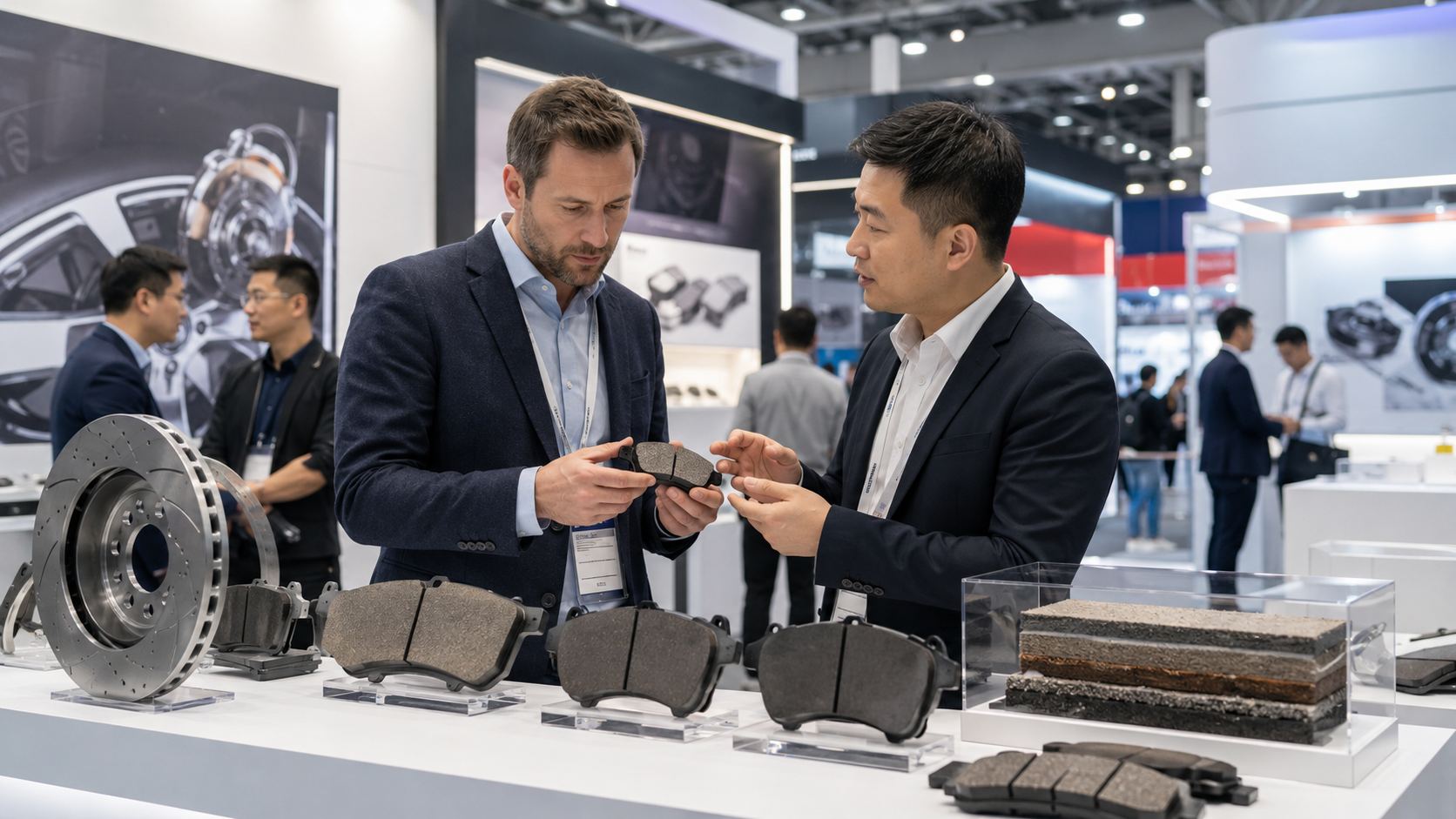
For sourcing professionals seeking brake pad manufacturer China trade show opportunities, the path to direct factory partnerships runs through China’s specialized automotive exhibitions. In over ten years of organizing international trade fairs, I have watched thousands of global buyers struggle to distinguish genuine manufacturers from intermediaries online—only to build confident supply chains after a single day of face-to-face meetings at a well‑chosen event. A brake pad manufacturer China trade show gives you what no B2B platform can replicate: the ability to inspect material quality, verify production credentials, and negotiate terms directly with the factory floor, all under one roof.
Why a Brake Pad Trade Show in China Delivers What Online Sourcing Cannot
Every procurement manager I have spoken with at our events shares the same frustration before attending their first China brake exhibition. They have spent months comparing catalogs on Alibaba or Made‑in‑China, only to receive samples that diverge sharply from the listed specification. The issue is rarely that Chinese manufacturers lack capability. It is that without physical inspection, you cannot tell a production‑grade brake pad from one formulated for a different friction class and relabeled to meet your RFQ.
A trade show collapses that gap. You can handle the product, test‑fit it against a reference sample you bring, and read the technical data sheet while standing next to the engineer who signed it. You see secondary evidence that no online profile reveals: whether the company invested in a dedicated exhibition booth with live demo units, whether their commercial team has the language skills to discuss your specific certification stack, and whether the contact person can answer a compound‑level question on the spot. These signals form the basis of a sourcing decision far faster than any remote audit.
China’s Brake Pad Manufacturing Clusters and the Shows That Connect Them
Brake pad production in China is not evenly distributed. It concentrates in a few industrial clusters that have spent decades building specialized supply chains, and the most productive trade shows deliberately position themselves where the factories are.
Ruian, in Zhejiang province, remains the densest hub for brake system components. Hundreds of manufacturers operate within a small radius, producing friction formulations from standard semi‑metallic compounds to ceramic and low‑metallic blends. At exhibitions such as the APES Auto Parts Expo Shanghai, Ruian‑based brake pad companies regularly attend in organized pavilions, making it possible to benchmark six or seven suppliers in a single hall without leaving the brake section. Yuhuan, also in Zhejiang, brings equal depth in chassis and brake parts, often offering integrated systems that combine pads, discs, and calipers from the same foundry group. The cluster effect matters because it gives you negotiation leverage: you can reference a competing factory’s pricing from the booth two rows down, and the supplier knows you are not bluffing.
Choosing the right show means matching the exhibition’s buyer profile to your market. APES 2026 is expected to draw organized buyer delegations from over 100 countries, with a deliberate matchmaking component that connects Southeast Asian and Middle Eastern procurement teams directly with exhibiting manufacturers. The exhibition’s “Internet + Exhibition” model adds a pre‑screening layer: before you travel, you receive exhibitor capability profiles, ISO and IATF 16949 certification status, and product range details, so you can book a shortlist of meetings rather than wandering aisles.
Exhibition Region
Representative Brake Clusters
Typical Buyer Profile
Shanghai
Ruian, Yuhuan, Wenzhou brake parts
Global aftermarket distributors, OEM Tier 2 purchasers
System integrators sourcing multiple component categories
North China (Hebei)
Qinghe, Shiyan commercial vehicle clusters
Heavy‑duty truck and bus fleet buyers
How to Evaluate a Brake Pad Manufacturer on the Show Floor
The booth visit should be structured. I advise starting with a fifteen‑minute technical script that many buyers neglect because they are drawn into small talk or generic capability claims. Bring a printout of your market’s regulatory requirement—ECE R90 for Europe, SAE J661 for U.S. performance testing, or your regional variant—and ask to see the corresponding test report for a production batch, not a lab prototype. If the representative cannot produce a batch‑level test sheet within a reasonable time frame, treat that as a material red flag.
Next, go to the friction material. Physically examine the surface for uniform particle distribution. An uneven matrix under a simple magnifier often signals inconsistent mixing, which translates into noise, vibration, and uneven wear in the field. Ask how long the manufacturer has run the current formulation and request the wear‑rate curve at your target operating temperature range. A supplier that can give you a specific mileage‑to‑temperature curve understands application engineering; one that only quotes a generic “30,000‑mile lifespan” is reciting a catalog.
The booth’s layout itself sends a message. Companies that invest in a raw‑space booth with cutaway demo rigs and independent technical staff separate themselves from traders who hang a few sample boards in a standard shell scheme. I have seen experienced buyers walk past a polished trade‑only booth to spend time at a smaller manufacturer’s stand because the smaller exhibitor brought a brake dyno trace printout and was willing to discuss failure modes. Substance is louder than decoration at a brake parts show.
If your program involves brake pads destined for a vehicle platform that already has an existing homologation file, it is worth confirming whether the supplier has conducted in‑vehicle conformity testing with that specific platform before you proceed past the first meeting. Send the detail to apeschina@huamogroup.com and we will help you identify exhibiting manufacturers with on‑record platform experience.
Negotiation and Partnership Setup Right Inside the Exhibition Hall
The conversation should move from quality to commercial terms while you are still face‑to‑face. One mistake I see consistently is buyers accepting a first‑tier price as if it were a factory‑gate offer, without clarifying whether it applies to the aftermarket channel, the OEM service channel, or an own‑brand program. These three channels carry different pricing, and a brake pad manufacturer often quotes the highest‑margin channel first.
Lay out your forecast volume in units per month, not containers, and ask for the price breakpoints. A reputable factory will have a tiered price matrix that aligns with raw material lot sizes. If the contact immediately agrees to the lowest price without referencing material‑lot economics, you are likely dealing with a trading company that marks up and then discounts to create an illusion of negotiation. I also recommend asking to handle the brake pad’s production sample that is not on the display board—the one kept behind the counter for serious buyers. That sample often reveals the true edge chamfer, backing plate coating, and shim quality better than the polished display piece.
At this stage, confirm the quality assurance documentation you will receive before the first shipment: material certifications, functional dimension reports, and thermal‑cycling test results. Request them in writing on the company letterhead, not in a WeChat message. The goal is to leave the fair with a draft Purchase Agreement or at minimum a clear commercial terms sheet, not merely a stack of catalogs. If the supplier resists putting even preliminary commitments on paper, that behavior tends to magnify once you are back home and dependent on email.
After the Trade Show: Making Follow‑Up Accelerate Instead of Stall
The seventy‑two hours immediately after the exhibition are the highest‑conversion window. I urge every buying team to send a structured follow‑up within that period: reference the specific compound and pad shape discussed, attach the photo you took of their dyno report, and propose a mutually acceptable date for a video‑call factory audit if an on‑site visit is not possible. A follow‑up that reads “nice to meet you” will be ignored; a follow‑up that reads “you mentioned your ceramic formulation passes the 550°C fade test at 0.42μ; can you share the full test‑cycle data for our engineering review?” signals serious intent and typically gets a reply within twenty‑four hours.
Schedule a factory visit for the same trip if your schedule allows. A plant visit reveals things the booth cannot: whether the mixer is a high‑speed vertical type suitable for consistent friction material blends, whether curing ovens follow a traceable time/temperature profile, and how the factory separates production‑critical operations from general assembly. When I accompany buyers on such visits, the decision‑makers consistently say that the forty‑minute walk through the production floor clarified their supplier ranking more than the entire previous two days of exhibition meetings.
Once you return to your home market, consolidate your notes into a weighted evaluation matrix that covers technical capability, commercial flexibility, communication quality, and lead‑time reliability. The highest‑scored candidate should receive a trial order within four weeks. Momentum decays quickly, and the manufacturers you met are simultaneously being courted by buyers from other regions.
Common Questions from Brake Pad Buyers Planning a China Trade Show Visit
Do I need a China‑specific trade show, or will a global exhibition cover my needs?
A global show like Automechanika Shanghai certainly attracts brake pad exhibitors, but the density of domestic Chinese manufacturers is lower than at a specialized exhibition like the APES Auto Parts Expo, which deliberately clusters the industrial supply base. For focused brake pad sourcing, a show that brings together the Zhejiang‑region manufacturers under one roof gives you a comparative advantage you cannot replicate at a generalist event.
Can I negotiate factory‑direct pricing at the exhibition itself?
Yes, and in many cases you should. The factory’s commercial director is present precisely to close volume commitments. That said, the pricing you secure will depend on your ability to define your channel, volume, and quality specification during the conversation. Bring your historical purchase data and a clear spec sheet. Bargaining without technical substance signals a low‑value buyer.
What certifications should I look for on the booth?
For aftermarket brake pads heading to regulated markets, ECE R90 certification documentation is the minimum. For OEM or service‑channel supply, IATF 16949 is the gold standard that separates systematic quality management from ad‑hoc inspection. If the booth displays only generic ISO 9001 certificates, ask directly: “Has your friction material passed ECE R90 homologation by an accredited laboratory?” The answer often separates serious export manufacturers from local‑only players.
How do I handle language barriers?
At any professionally organized auto parts exhibition in Shanghai, each booth typically staffs at least one English‑speaking commercial representative. However, for technical validation, I recommend bringing a bilingual sourcing agent or interpreter who understands brake‑system terminology specifically, not just general business English. The phrase “friction coefficient” interpreted as “resistance performance” can cost you a wrong shipment.
Is it worth visiting multiple brake pad clusters in the same trip?
If your schedule permits two clusters, Ruian and Yuhuan are geographically close enough in Zhejiang to combine in a single three‑day itinerary. The factories in these areas often share raw material suppliers and occasionally compete on the same global tenders, so visiting both strengthens your benchmarking. Share your intended plant‑visit schedule with apeschina@huamogroup.com or call +021-60280788, and we can help coordinate logistics across the Zhejiang industrial belt to maximize your time.
If you’re interested, check out these related articles: