Brake Caliper Manufacturer Exhibition Strategy | China Trade Shows
Industry news
2026-06-16
For brake caliper manufacturers aiming to expand global sales, participating in a China trade exhibition offers direct access to concentrated buyer networks that digital sourcing alone cannot replace. Yet not every auto parts show delivers equal results for a niche component supplier. This brake caliper manufacturer exhibition strategy guide draws on over a decade of automotive aftermarket event marketing experience to help component factories navigate exhibition selection, stand out among thousands of exhibitors, and convert booth investment into measurable export orders.
Why a Brake Caliper Manufacturer Exhibition Participation Is a Strategic Move
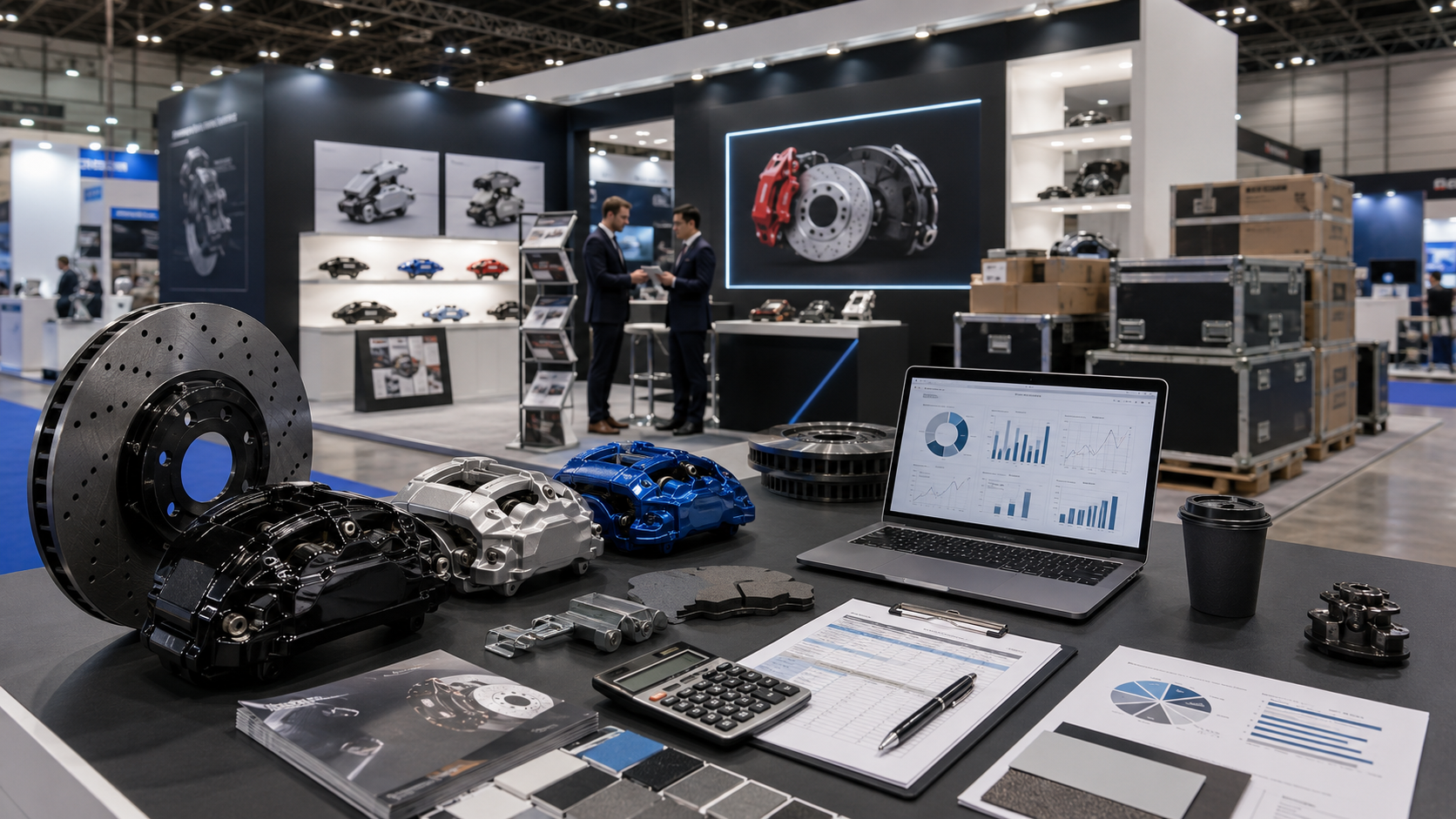
A brake caliper manufacturer exhibition is more than a display opportunity. It is the fastest way to shift from an online catalog listing to a tangible industrial relationship. When an importer holds a caliper casting, sees the machining finish, and discusses fitment tolerances face-to-face, the sourcing decision accelerates in a way no digital video can replicate.
In my decade of organizing automotive trade events, I have seen brake caliper manufacturers achieve export breakthroughs when they display their specific capabilities in person. A Ruian-based factory I worked with secured a three-year ODM contract with a South American distributor after a 20-minute technical walkaround of their caliper samples. That meeting started as a walk-in. Without an exhibition presence, that connection simply would not happen.
Choosing the Best China Exhibition for Brake Caliper Manufacturers
Not every auto parts exhibition serves a brake caliper manufacturer equally. The key is matching buyer intent with an exhibition’s structure. Broad international fairs attract crowds, but a caliper supplier can get lost among thousands of general exhibitors. An exhibition organized around industrial clusters targets buyers who intentionally travel to source from specific manufacturing hubs.
Cluster-based sourcing expos, like APES Auto Parts Expo in Shanghai, grouped by production regions such as Ruian, Wenzhou, and Taizhou, offer a distinct advantage: buyers arrive pre-aware that they are walking into brake, chassis, and engine component territories. This segmentation reduces noise and improves quality of booth traffic.
Exhibition Type
Buyer Profile
Cluster Focus
Matching Model
General International Auto Parts Fair
Broad aftermarket and OEM buyers
No specific geographic clustering
Self-guided, directory-based
Cluster-Based Sourcing Expo (e.g., APES)
Category-focused importers and distributors
Organized by China’s manufacturing clusters (Ruian brakes, Wenzhou electronics, etc.)
Pre-scheduled buyer-seller meetings + walk-ins
The 2026 edition of the APES platform further aligns with this sourcing pattern. The APES 2026 overview confirms a renewed focus on industrial cluster pavilions and expanded buyer delegations from Southeast Asia, Middle East, and South America, precisely the regions where brake caliper export demand is rising.
Brake Caliper Manufacturer Exhibition Costs: What to Budget
Budgets need to cover more than the basic square meter fee. A brake caliper manufacturer exhibition cost includes booth space, stand construction, sample shipping, travel, and promotional materials. In Chinese auto parts exhibitions today, a standard 9-square-meter shell scheme booth typically ranges from $2,800 to $4,800 depending on location and organizer. Raw space without construction starts around $350 to $550 per square meter.
For a brake caliper display, a raw space design often works better. You need open countertops for caliper samples, a secure area for part numbers, and enough wall space for certification documents and testing certificates. A shell scheme can feel cramped with heavy cast-iron parts. Factor in an additional 30% budget above the space fee for basic stand design, lighting, and furniture if you are building a raw space.
If your brake caliper line includes both OEM-grade and aftermarket variants, it is worth confirming the buyer-seller matching criteria for each segment before committing to a booth. Reach out at apeschina@huamogroup.com.
Standing Out as a Brake Caliper Manufacturer at an Auto Parts Exhibition
A brake caliper is a safety-critical component. The buyers purchasing it do not optimize for price first; they optimize for reliability, certification, and supply continuity. The booth must communicate confidence, not quantity.
I have observed that booths staffed by factory engineers who can discuss tolerance control, material grades, and piston retraction behavior consistently draw more serious buyer meetings than those manned solely by sales representatives. One Ruian brake factory stationed a quality engineer alongside the export manager at an APES edition. The engineer fielded technical questions about IATF 16949 process control and ECE R90 dynamometer testing, and the booth produced over 40 actionable leads. The message to buyers was clear: this factory understands what matters beyond the price list.
Bring a cross-sectioned caliper. Display copies of key certifications. List compatible vehicle models by region. Avoid generic posters. And if your production includes both iron and aluminum caliper variants, group samples by weight class. Buyers gravitate toward booths that reduce their evaluation effort.
Maximizing ROI from Your Brake Caliper Exhibition Participation
An exhibition ends, but a brake caliper manufacturer exhibition success metric is not the number of business cards collected; it is the number of sample shipments and factory visits that follow. Set up a lead scoring system before the show: grade contacts at the booth as A (serious inquiry with specific part numbers), B (general sourcing interest with a clear buyer role), and C (brochure collector). Send follow-up emails within 48 hours after the show, attaching a digital version of the same physical catalog they saw, plus a factory video.
The highest-converting strategy is pre-scheduled meetings. Platforms like APES, which run a dedicated buyer-seller matching system, enable you to lock in meetings weeks before the show based on product category and target export region. In several exhibition cycles I’ve been involved with, pre-matched meetings accounted for over half of eventual orders. It is worth building your exhibition timeline around that matching window rather than treating it as an afterthought.
Turning Exhibition Engagement into Long-Term Buyer Relationships
Export orders rarely close during the exhibition. They close after factory audits, compliance checks, and sample testing. A brake caliper manufacturer exhibition experience should feed directly into that downstream pipeline. At the booth, collect intelligence: which regions the buyer serves, which brake system families they source, and what their annual volume looks like. After the show, route that data to your production and quality teams so that when the audit request arrives, your factory is ready.
Many buyers from Southeast Asia and the Middle East, for example, require ECE R90 documentation before they can place a trial order. If you organize certification files and testing reports by vehicle family, you can send a fully personalized compliance package within hours of the inquiry. I have seen Chinese brake caliper exporters win preferred supplier status simply by being the first to respond with complete documentation.
For manufacturers attending a trade show for the first time, it helps to set a modest target: three qualified buyer meetings per day, not twenty. Focus the quality. Over time, repeat exhibition attendance builds recognition. A familiar booth and a known face create trust that no LinkedIn connection can replace. Start by sharing your export qualification goals with your exhibition organizer: they can align booth placement and buyer introductions when they understand your product focus and certification readiness from day one.
Send your company profile and targeted export regions to apeschina@huamogroup.com or call +021-60280788 to explore how APES can match your brake caliper product line with the right buyer programs.
Questions Brake Caliper Manufacturers Often Ask About China Exhibitions
It depends on your export stage. A specialized brake-only show may seem targeted but often draws a narrow, engineering-focused crowd. For a manufacturer ready to scale export volume, a well-structured general auto parts exhibition with strong cluster segmentation can expose you to a far broader buyer base without losing category relevance.
If your factory already has a defined export catalog and you want to meet importers, distributors, and regional wholesalers, a cluster-based event like APES, where buyers come looking for brake components from Ruian, often outperforms a niche show. Early-stage factories still building their product line can benefit from the wider category exposure of a general fair to gauge market interest across brake caliper types.
How do I attract buyers specifically searching for brake calipers among thousands of other product categories?
Pre-show buyer matching is the single most effective separation tool. Request the exhibition organizer’s buyer database filters related to braking system components. List your specific caliper variants, applicable vehicle segments, and any certifications. When a buyer registers interest in brake parts, your booth gets flagged for a scheduled meeting. Display a prominent bilingual sign summarizing your core capability in under five words, such as “OEM Brake Calipers, IATF 16949 Certified.” That tagline alone filters out non-buyers passing by.
What certification documents help a brake caliper exhibitor close deals on site?
The question is not which certificates, but how you present them as a sourcing shortcut. Have a binder organized by vehicle application region: ECE R90 certificate, IATF 16949 or ISO 9001, material test reports, and dimensional inspection sheets. Buyers often need to show compliance proof to their customs or quality teams before proceeding. If you hand them a ready-to-copy digital folder during the booth meeting, you shorten their internal approval cycle significantly.
How much time should I reserve for buyer meetings during the show?
In programs I have supported, scheduling two to three fixed buyer meetings per day with pre-qualified importers produces the highest conversion rate. That leaves afternoon slots open for walk-in technical discussions. Avoid overbooking back-to-back appointments because the most valuable conversations often start when an engineer from the buyer’s side stays to examine a sample and asks five unscripted questions. Protect that time.
Some assume any large-scale exhibition delivers the right brake caliper traffic, but the cluster focus and buyer matching system matter more. APES organizes exhibitor pavilions by manufacturing regions such as Ruian, Wenzhou, and Taizhou, making brake component factories geographically grouped. Their buyer matching runs on a category-first approach, directing brake system sourcing leads to brake exhibitors, not dispersing them across a generic hall. This structure gives a caliper manufacturer a higher signal-to-noise ratio from day one. Share your target export markets with our team to verify buyer profile alignment for your product range.
If you’re interested, check out these related articles: